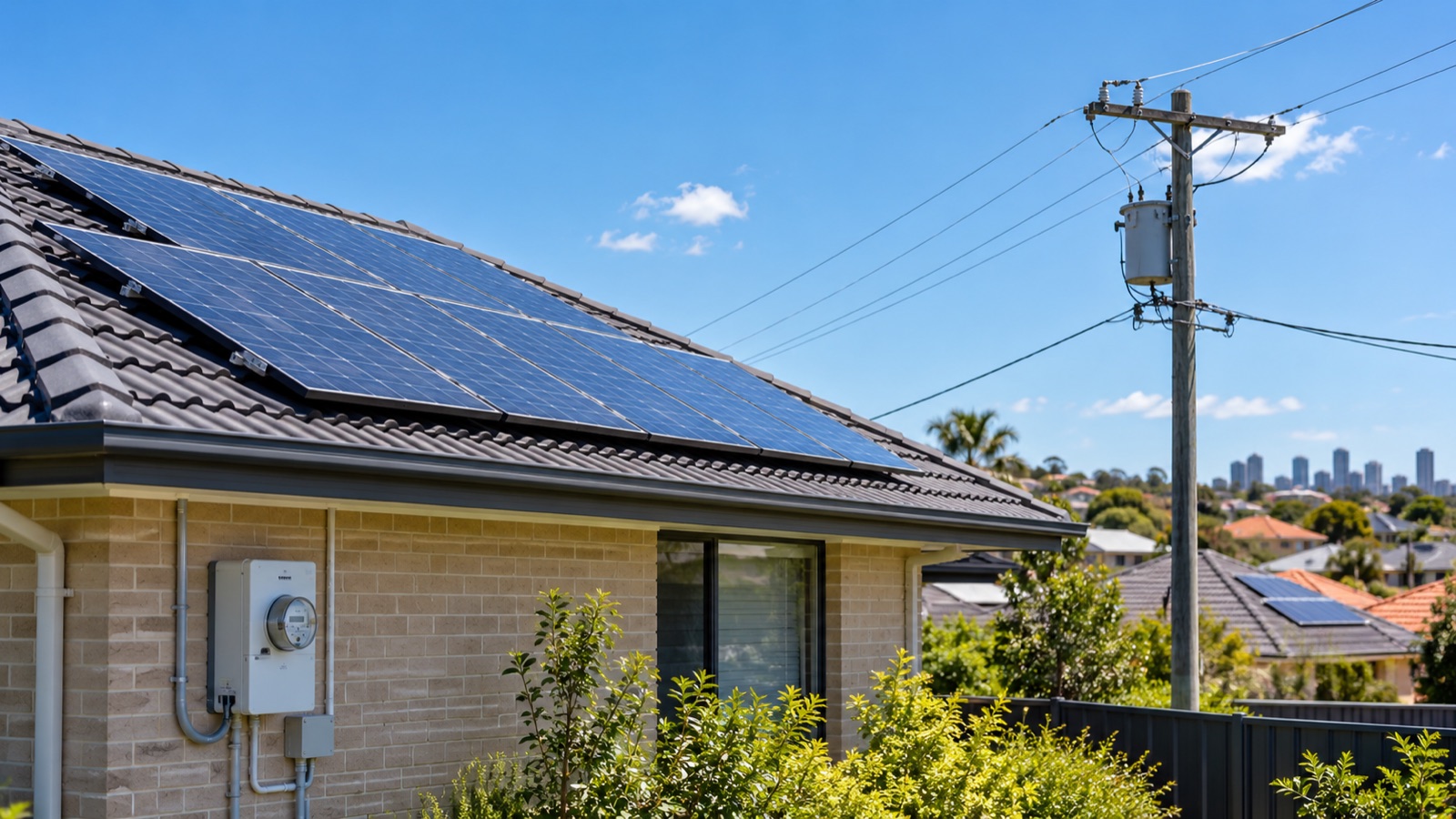
Ten years ago the argument for solar in SA was the feed-in tariff. Today the argument for a battery is the lack of one. This page explains what SA retailers actually pay for exports in 2026, what the SA Power Networks export tariff is, and how the time-of-use windows work – because those three things, not the rebate, decide whether a battery pays for itself.
What SA retailers pay for solar exports in 2026
- Standard offers: 0 to 5c/kWh. Some standard retail contracts now pay nothing at all for exports, and 3 to 5c is common.
- Solar plans: 5 to 8c/kWh on a daily block. The typical structure is 8c for the first 8 to 10kWh exported each day, then 1 to 3c. A 6.6kW system exports 15 to 25kWh on a good day, so most of it earns the lower rate.
- Battery plans: 18 to 28c/kWh, but only in the evening. AGL’s Battery Rewards plan pays around 28c/kWh for exports between 5pm and 9pm and Origin’s Battery Maximiser lists 22c at peak – both for battery households, both worth checking for conditions and the usage rates that come with them.
- Wholesale plans: whatever the market pays. Amber passes through the wholesale price, which in SA swings from negative at midday to spikes in the evening – only sensible with a battery that can time exports.
The number that matters for a battery is the gap between what you pay at peak (40 to 59c/kWh on SA time-of-use plans) and what you get for exporting (0 to 8c). At a 35 to 50c gap, every kWh a 10kWh battery shifts from lunchtime export to evening use is worth 35 to 50c – roughly $1,000 to $1,500 a year on a typical SA family’s usage. That is the whole business case, and it improves every time a feed-in tariff is cut.
The SA Power Networks export tariff
Since 1 July 2025 SA Power Networks – the company that owns the poles and wires, not your retailer – has applied an export tariff to residential and small-business customers who can export through solar, batteries or vehicle-to-grid, with inverters up to 30kW. It works like this:
- Window: 10am to 4pm. Exports from 4pm to 10am are free of the charge.
- Free allowance: the first 9kWh exported per day in that window (11kWh for older accumulation meters).
- Charge above the allowance: about 1c/kWh (0.75c on accumulation meters), billed to your retailer, which may pass it through, absorb it or build it into plan pricing.
- Applies to batteries and V2G too – discharging a battery to the grid at 1pm counts, discharging it at 6pm does not.
At 1c/kWh the charge itself is small – a large system might pay $30 to $60 a year. Its real significance is the direction: the network is telling you midday exports are a cost, not a product, while its separate Electrify tariff rewards evening flexibility. A battery is the piece of hardware that lets you sell into the window the network actually wants.
SA Power Networks time-of-use windows
| Tariff | Peak | Off-peak | Solar sponge (cheapest) |
|---|---|---|---|
| Residential time of use | 6am to 10am and 4pm to midnight | Midnight to 6am | 10am to 4pm |
| Controlled load (hot water) | 6.30am to 9.30am and 4.30pm to 11.30pm | 11.30pm to 6.30am | 9.30am to 4.30pm |
| Electrify (opt-in) | 5pm to 9pm | Shoulder 9pm to 10am and 4pm to 5pm | 10am to 4pm |
SA Power Networks residential network tariff windows, every day including weekends. Your retailer’s plan may use these windows or its own.
The solar sponge window is the cheapest network period of the day and is deliberately placed over the solar peak. With a battery, the playbook is simple: run the house and fill the battery from 10am to 4pm, then coast through the 4pm to midnight peak on stored power. If you are on a Solar Sharer plan, the 12pm to 3pm part of that window is free.
What this means for the battery decision
- Already have solar and export most of it? You are earning 0 to 8c on power you could be using at 40c or more. A battery is the fix, and the federal rebate takes about $2,520 off a 10kWh unit.
- On a generous legacy feed-in tariff? If you still receive the old 44c/kWh SA government tariff (which runs until mid-2028 for eligible pre-2011 systems), a battery is usually not worth it until that ends – keep exporting.
- No solar yet? Go straight to a solar and battery package; sizing the two together is cheaper than retrofitting, and the rebate needs solar on the property anyway.
Stop exporting for 5c - get a battery quote
Exclusive - your details go to one licensed local installer, not five.
Feed-in tariffs and export charges – FAQs
What is the best solar feed-in tariff in SA in 2026?
For ordinary solar plans, around 8c/kWh on the first 8 to 10kWh exported each day is as good as it gets, with 1 to 3c after that. Higher headline rates (18 to 28c) are battery-only plans that pay for evening exports, usually with conditions and higher usage rates.
Is there a ‘sun tax’ in South Australia?
SA Power Networks applies an export tariff of about 1c/kWh on exports above 9kWh a day between 10am and 4pm. Exports outside that window and the first 9kWh inside it are free. It is charged to retailers, who decide how to pass it on.
Does the export tariff apply to batteries?
Yes – it applies to any export in the 10am to 4pm window, whether from solar, a battery or a vehicle-to-grid charger. Discharging a battery in the evening is not charged.
Why are SA feed-in tariffs so low?
SA has the highest rooftop solar penetration in the world and wholesale prices routinely go negative in the middle of the day, so exported solar is worth little or nothing to retailers at that time. The value has shifted to the evening, which is what a battery captures.
Related: Solar Sharer free hours · Is a battery worth it in SA? · Battery payback calculator · Best VPP in SA